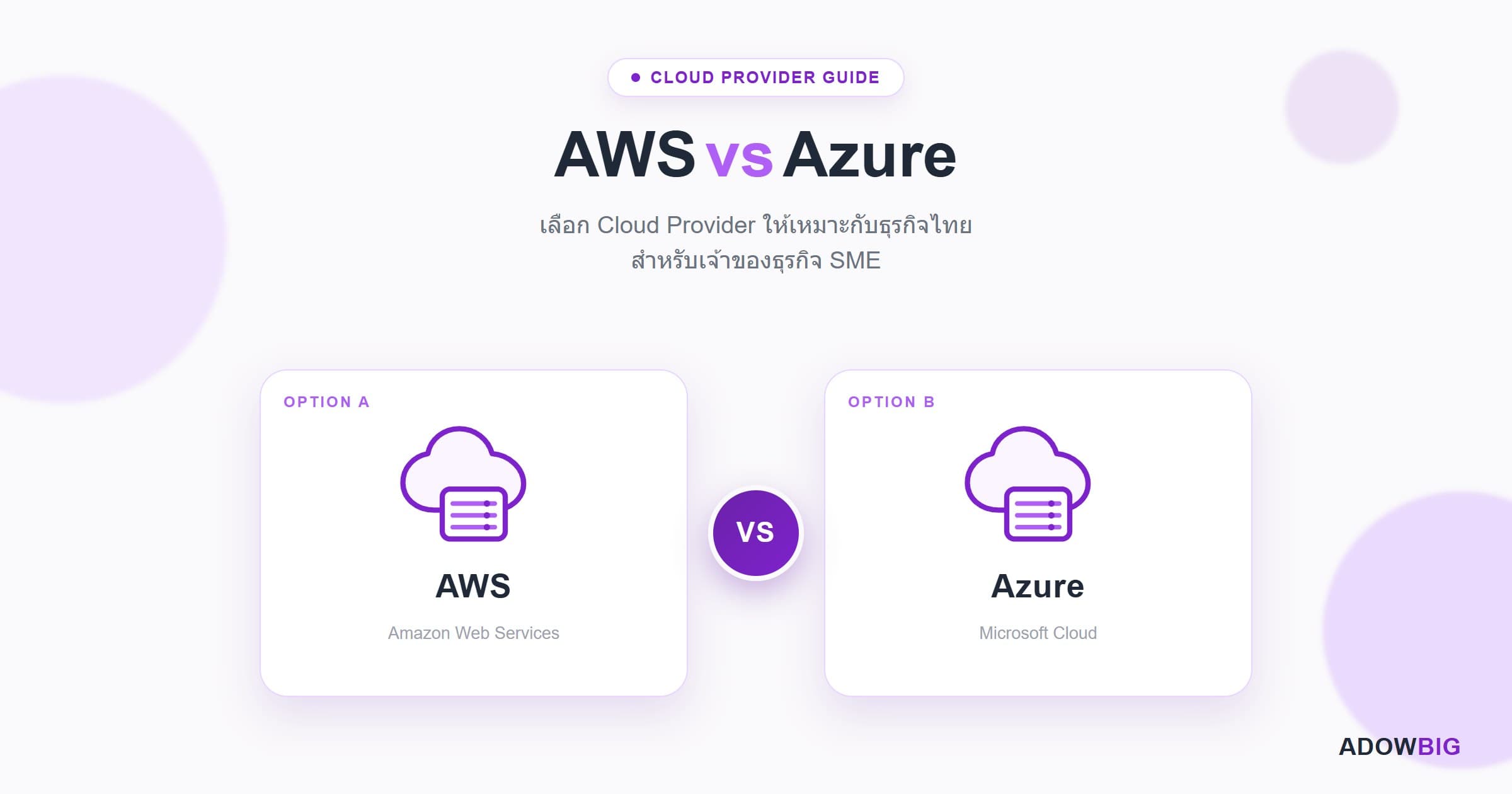
If you are planning to migrate systems to the cloud or build new systems on cloud infrastructure, AWS versus Azure is often the first decision on the table.
Both are excellent enterprise-grade platforms. The right choice, however, depends significantly on your specific context as a Thai business.
The Landscape
Amazon Web Services (AWS) — the current market leader at roughly 31% market share, with 200+ services covering every conceivable cloud need. AWS has been operating since 2006 and has the deepest feature set.
Microsoft Azure — the number two provider at approximately 25% market share, exceptionally strong in enterprise integration, especially within the Microsoft ecosystem.
Key Comparison for Thai SMEs
| Factor | AWS | Azure |
|---|---|---|
| Data center in Thailand | ✅ Bangkok Region (2023) | ❌ Nearest is Singapore |
| Latency for Thai users | Very low (<10ms) | Moderate (30–60ms) |
| Microsoft ecosystem fit | Moderate | Excellent |
| Free tier | 12 months + always-free select services | 12 months + always-free |
| Overall pricing | Comparable | Comparable |
| Thai market community | Larger | Moderate |
| Thai implementation partners | Many | Available but fewer |
When AWS is the Better Choice
You need a data center in Thailand. The AWS Bangkok Region (opened 2023) delivers very low latency for Thai users — critical for real-time applications like e-commerce, POS systems, and live dashboards. It also addresses data residency requirements for Thai compliance.
Your stack is not tied to Microsoft. If your infrastructure is Linux-based, uses open-source databases like PostgreSQL or MySQL, and deploys via Docker or Kubernetes, AWS has a broader ecosystem and a larger Thai community for support.
AI and ML are on your roadmap. AWS SageMaker, Bedrock (Generative AI), and Rekognition are mature services with strong adoption among Thai companies. If AI is a clear part of your future plans, AWS is a strong foundation.
When Azure is the Better Choice
You already use Microsoft stack. Office 365, Active Directory, SQL Server, Power BI — Azure integrates seamlessly with all of these, and Microsoft licensing bundles can make the economics more attractive.
Enterprise identity management matters. Azure Active Directory (now Entra ID) is the industry standard for enterprise Single Sign-On. For organizations with hundreds of employees needing centralized authentication, Azure's tooling is unmatched.
Your team develops in .NET. If your primary technology is C# or ASP.NET, the Azure developer experience with deep Visual Studio and Azure DevOps integration is genuinely excellent.
Factors to Consider Before Deciding
Long-term cost: Both platforms have complex pricing structures. Run estimates through the AWS Pricing Calculator and Azure Pricing Calculator before committing. Do not rely on rough estimates.
Team expertise: Which platform is your DevOps team already familiar with? The learning curve represents real cost.
Vendor lock-in: Managed services like AWS RDS or Azure Cosmos DB are convenient but create dependency. If portability matters to you, prioritize container-based deployment from the start.
Support: Enterprise support plans from both providers are expensive. A Thai managed service partner (MSP) often provides faster, more contextually relevant support for local businesses.
The Bottom Line
- Choose AWS if you need a data center in Thailand, your team is comfortable with Linux and open-source stack, or AI/ML is a significant part of your roadmap.
- Choose Azure if you have an existing Microsoft ecosystem, enterprise identity management is important, or .NET is your primary development technology.
The Adowbig team has deployed production systems for clients on both AWS and Azure. Contact us for a free architecture consultation.