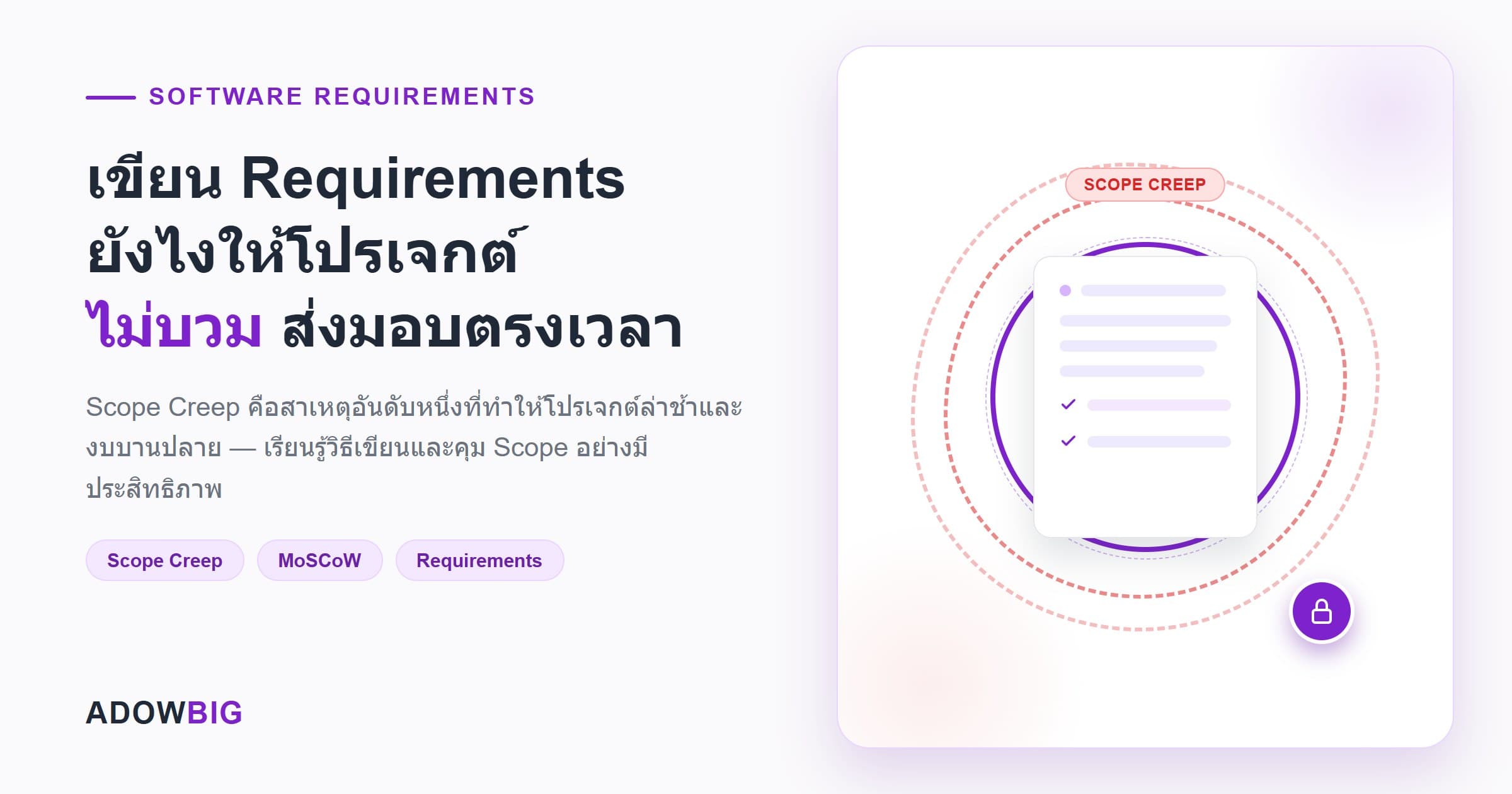
According to the Standish Group Chaos Report, fewer than 30% of software projects finish on time and within budget. The #1 cause: scope creep — unplanned feature expansion.
This article teaches you how to define, document, and manage software project scope effectively.
What Is Scope Creep?
Scope creep occurs when features or requirements expand during the project without going through a formal approval process.
Common examples:
- "Can you add PDF export too?" (1 week of work)
- "Make the system support 5 languages." (3 weeks of work)
- "I want a mobile app too — didn't I mention that?" (significant)
Each request seems small, but combined they can delay a project by months and double the budget.
Why Unclear Requirements Are Dangerous
Unclear requirements cause:
- Developers have to guess — wrong guesses mean rework
- Untestable features — no way to know if a feature passes or fails
- Inaccurate timelines — no way to estimate scope
- Stakeholder conflicts — one person understands one thing, another understands something different
A Framework for Writing Good Requirements
1. Functional vs Non-Functional Requirements
Functional Requirements = what the system does
- "Users can log in with email + password"
- "Admins can add/edit/delete products"
- "System sends email confirmation when an order is placed"
Non-Functional Requirements = how the system behaves
- "Pages load within 2 seconds on a 3G connection"
- "Supports 500 concurrent users"
- "99.5% monthly uptime"
Both matter equally, but non-functional requirements are often forgotten — they define system quality and infrastructure.
2. Write User Stories Instead of Feature Lists
Instead of writing: "There is a notification system"
Write a User Story:
"As a customer, I want to receive an SMS when my order is shipped so that I can prepare to receive the package."
Format: "As a [role], I want to [action] so that [benefit]"
Good User Stories follow INVEST criteria:
- Independent — can be built separately from other stories
- Negotiable — scope can be discussed
- Valuable — delivers value to users or business
- Estimable — can be time-estimated
- Small — small enough to complete within a sprint
- Testable — has measurable acceptance criteria
3. Acceptance Criteria — Never Skip These
Every User Story needs clear Acceptance Criteria.
Example:
User Story: Users can log in with email + password

Acceptance Criteria:
✅ Correct email + password → redirect to dashboard
✅ Wrong password → show "Incorrect password" error
✅ 5 failed login attempts → lock account for 15 minutes
✅ Click "Forgot password" → send reset link to email
Acceptance Criteria define what "done" actually means for a feature.
MoSCoW Prioritization
When you have more features than budget, use MoSCoW:
| Bucket | Meaning | Example |
|---|---|---|
| Must Have | Without this, the system doesn't work | Login, CRUD operations |
| Should Have | Very important but workable without | Export reports, email notifications |
| Could Have | Nice to have | Dark mode, multi-language |
| Won't Have (now) | Cut from this phase | Mobile app, AI features |
Run MoSCoW with all stakeholders — never alone. Different people have very different views on priority.
A Good Change Request Process
When requirements change, use a formal Change Request process:
Steps:
- Submit Change Request with details on what's needed and why
- Impact Assessment — software house evaluates effect on timeline, budget, dependencies
- Approval — authorized stakeholder approves or rejects
- Update Scope Document — formally revise scope documentation
- Implement — only begin work after approval
Golden rule: Nothing changes without formal approval.
Short Requirements Document Template
# [Project Name] Requirements v1.0

## 1. Background
[Problem to solve and business context]

## 2. Goals
- Goal 1: [measurable]
- Goal 2: [measurable]

## 3. Users
| Role | Description | Primary Device |
|------|-------------|----------------|
| Admin | Manages the system | Desktop |
| Customer | Purchases products | Mobile |

## 4. User Stories (Must Have)
- US-001: As a... I want to... so that...
  - AC: ✅ ...

## 5. Non-Functional Requirements
- Performance: pages load in 2s on 4G
- Security: personal data encrypted at rest
- Availability: 99.5% monthly uptime

## 6. Explicitly Out of Scope
- Mobile app not included
- Multi-language not included

## 7. Open Questions
- [ ] Which payment gateways must be supported?
Summary
Good requirements are the foundation of successful projects:
- Clear — everyone understands the same thing
- Testable — "done" has a measurable definition
- Prioritized — everyone knows what matters most
- Managed — changes have a formal process
Projects that invest time in requirements upfront deliver faster, cheaper, and closer to expectations.
The Adowbig team includes a Business Analyst in every project's discovery workshop to ensure requirements are solid before any code is written. Schedule a free discovery session