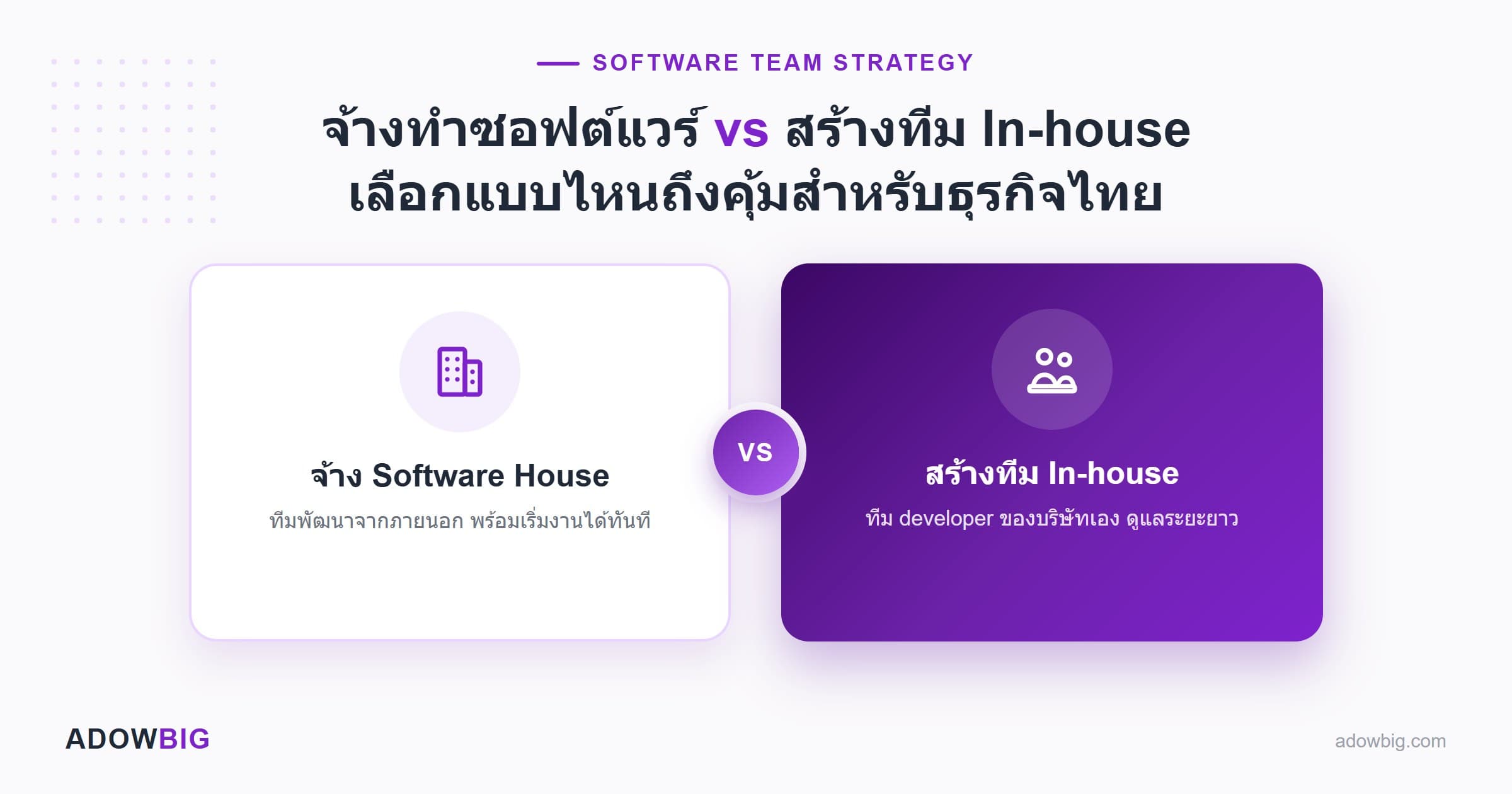
Every time a business decides to build new software, the question — "do we hire a software house or build our own dev team?" — paralyzes decision-makers.
Both paths have clear trade-offs, and there's no universally "correct" answer. But there is a thinking framework that makes the decision much clearer.
Understanding the True Cost of Each Option
The True Cost of Building In-House
Many people calculate: "2 developers × THB 80,000/month = THB 1,920,000/year." But the real cost is significantly higher:
- Salary + benefits — social security, health insurance, bonuses: add 20–30%
- Recruitment costs — headhunter fees or HR team time: THB 50,000–150,000 per hire
- Onboarding & learning curve — time for new developers to ramp up: 1–3 months
- Tools & licenses — IDE, cloud, monitoring, collaboration software
- Turnover risk — a developer leaving mid-project is a massive hidden cost
- Missing roles — 2 developers don't include a PM, designer, or QA tester
The True Cost of Outsourcing
- Project cost — paid against a clear deliverable scope with no hidden extras
- Timeline risk — professional software houses have SLAs and accountability
- Knowledge transfer — front-end investment of time to share domain context
Direct Comparison
| Factor | In-House Team | Software House |
|---|---|---|
| Upfront cost | High (recruitment + onboarding) | Moderate (project deposit) |
| Long-term cost | Fixed monthly (salaries always run) | Variable (pay per project) |
| Speed to start | Slow (2–4 months to hire) | Fast (2–4 weeks) |
| Domain knowledge | High (built over time) | Must be recreated per project |
| Technology breadth | Limited to team's skills | Broader (multiple specialists) |
| Scalability | Slow (rehiring takes time) | Fast (scale team immediately) |
| Code ownership | 100% clear | Must be specified in contract |
5 Signals You Should Outsource
- The project has a defined, bounded scope — not open-ended ongoing work
- Product-market fit is still being validated — don't commit to fixed costs before you know it works
- You need diverse skills simultaneously — ML, mobile, backend, design at once
- Timeline is tight — need to launch in 3–6 months with no time to hire
- Company headcount is under 50 — too early for an in-house team to be cost-effective
5 Signals You Should Build In-House
- Software IS your core product (tech startup, SaaS company)
- Continuous development work year-round — backlog never ends
- You need to iterate extremely fast — daily deploys, short feedback loops
- Data is highly sensitive — banking, healthcare, government
- Budget and time for talent development — committed to a 1–2+ year investment
The Hybrid Model: What Most People Overlook
For SMEs who don't want to pick just one extreme — the Hybrid Model is often the answer:
Typical structure:
- In-house: 1 Tech Lead + 1 Product Manager → owns vision, architecture, roadmap
- Outsourced: Software House handles execution, feature development, QA
Why hybrid works:
- You control direction without bearing full-team overhead
- Flexible scaling up or down per project need
- Gradually builds internal knowledge until you're ready to hire a full team
Questions to Ask Before Deciding
- Is this software a core differentiator or just a business enabler?
- Do you have 3–6 months for recruitment, or do you need results sooner?
- Can your budget sustain fixed monthly costs long-term?
- Has your product been validated, or are you still in exploration?
- Do you have technical leadership who can manage an in-house team?
Conclusion
There's no right answer for every business, but the simplest framework is:
- Not yet validated, or budget-constrained → Outsource first
- Software is your core business and you're ready for long-term investment → In-house
- Somewhere in between → Hybrid
Adowbig operates as a transparent partnership — you own the code, co-plan every sprint, and approve every milestone. We're simply the professional team that executes your vision.