In 2007, Dropbox didn't start by building real software. Drew Houston made a simple 3-minute video explaining the concept of cloud storage and invited people to join a waitlist.
The result: 75,000 sign-ups overnight.
That was an MVP in its simplest form.
What Is an MVP?
An MVP (Minimum Viable Product) is the smallest version of a product that is:
- Functional — it actually works, not just a prototype
- Viable — it delivers enough value for real users to use
- Testable — it validates your key assumptions
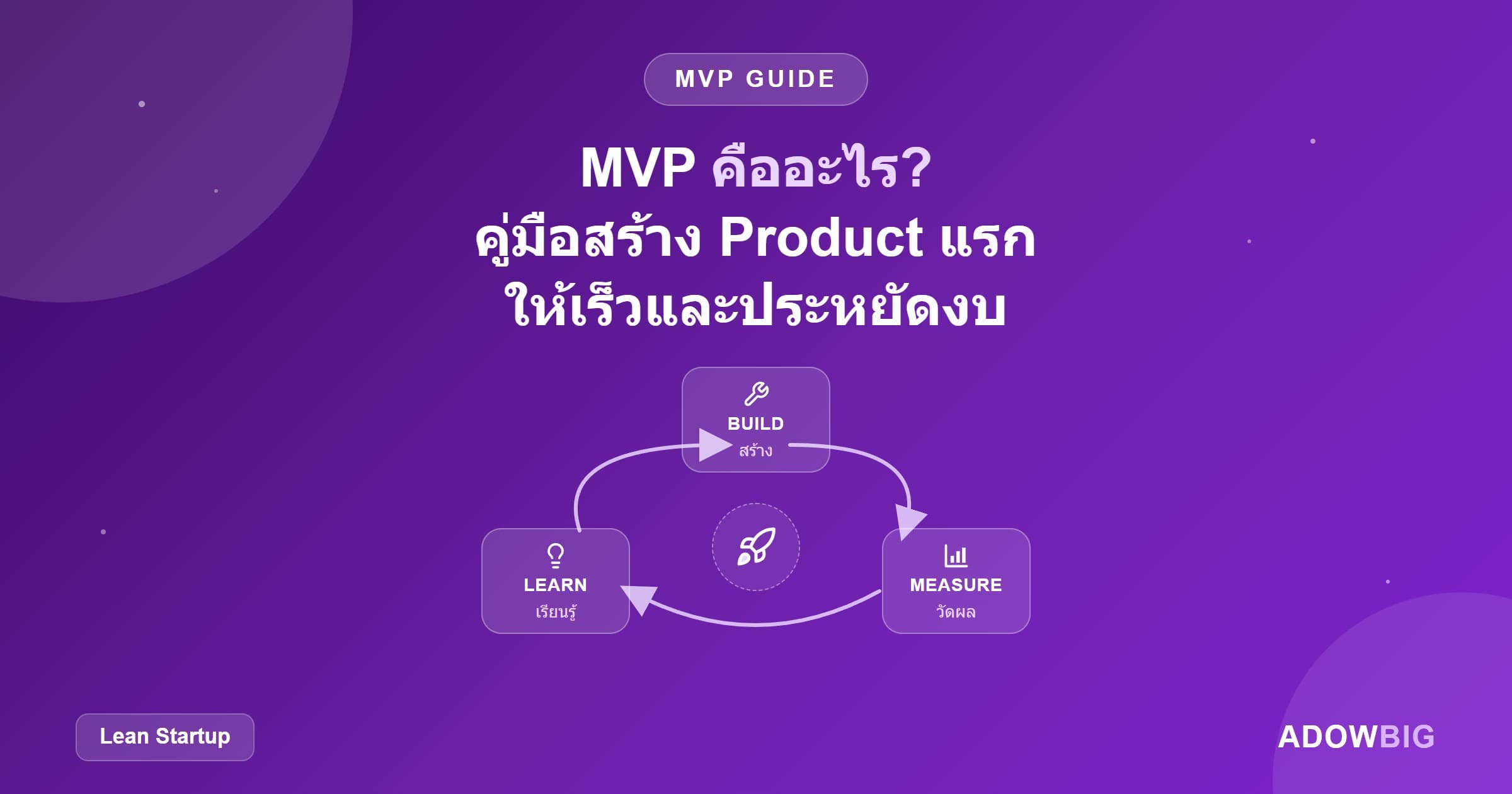
The concept comes from Eric Ries' "The Lean Startup", which introduced the learning loop: Build → Measure → Learn, repeated iteratively.
Why Build an MVP?
Save Money
A full-featured product costs 3–10x more than an MVP. Discovering the market doesn't want it after full investment is extremely expensive.
Learn the Truth Before You Invest
Assumptions like "customers will definitely love this" are frequently wrong. An MVP helps you get data from real users before committing full resources.
Get to Market Faster
An MVP launched in 2 months beats a full product launched in 18 months — markets shift and competitors don't wait.
Build Traction Before Funding
Investors want evidence that a product works and has real users. An MVP creates the traction you need.
Minimum, Viable, Product — Every Word Counts
Minimum ≠ Cheap or Broken
Minimum means the smallest version that's still viable — not the lowest quality you can get away with. If your MVP is hard to use or has terrible UX, people won't use it, and you won't get useful data.
Viable = Delivers Real Value
It must solve a real problem for a real user — even with just one feature.
Product = Something That Actually Works
Different from a prototype, demo, or landing page with no real functionality.
Steps to Build an MVP
Step 1: Define the Core Problem
Clearly identify what problem you're solving for whom. Example:
"Small restaurant owners spend 2 hours per day taking orders via LINE and frequently make mistakes → MVP: an automated online ordering system."
Step 2: Define Success Metrics Before You Launch
Decide in advance what "passing" looks like:
- 100 users register in 30 days
- 40% of users return in Week 2
- NPS score above 30
Step 3: List All Features and Cut to Core Only
| Feature | Necessary to validate core value? | Include in MVP? |
|---|---|---|
| Online order taking | ✅ Yes | ✅ Yes |
| Menu management | ✅ Yes | ✅ Yes |
| Loyalty points | ❌ No | ❌ No |
| Multi-branch support | ❌ No | ❌ No |
| Analytics dashboard | ❌ No | ❌ No |
Step 4: Build Agile
Break work into 2-week sprints. Release features incrementally — don't wait for everything to be complete before launching.
Step 5: Launch and Measure
- Set up analytics from day one (GA4, Mixpanel, Hotjar)
- Interview early users every week
- Track the metrics defined in Step 2
Step 6: Learn and Iterate
Every 2–4 weeks, run a retrospective:
- Did metrics reach targets?
- What do users complain about most?
- Which features go unused?
3 Successful MVP Examples
Airbnb
2008 MVP: A simple website letting San Francisco homeowners rent air mattresses to conference attendees. The founders personally photographed every home.
→ Validated "people will rent space in a stranger's home" before building a real platform.
Zappos
1999 MVP: Nick Swinmurn didn't buy shoe inventory first — he photographed shoes in local stores, posted them online, and bought them retail when someone ordered.
→ Validated "people will buy shoes online" before investing in a warehouse.
Buffer
2010 MVP: Joel Gascoigne built only a landing page saying "Social Media Scheduling Tool." If people signed up, demand existed.
→ Got the first paying customer before writing a single line of code.
Signs Your MVP Is Too Large
- Development will take more than 6 months
- Feature list has more than 20 items
- You have 4+ distinct user roles
- Requires 5+ system integrations
- You can't explain the core value in one sentence
Summary
An MVP isn't a bad product. It's a smart product.
Building a good MVP means:
- Defining the core problem clearly
- Ruthlessly cutting non-essential features
- Setting success metrics before launch
- Building fast, launching fast, learning fast
- Iterating from real feedback — not meeting room opinions
The world's most successful businesses didn't get it perfect on day one. Every one of them learned from an MVP.
Ready to build an MVP for your idea? Contact the Adowbig team to start a free discovery session.