Since ChatGPT launched in late 2022, the business world has changed fast. But many Thai businesses are still stuck asking "how should we use AI?" — without knowing where to start.
This article answers that question with real use cases. No hype.
What Is an LLM?
A Large Language Model (LLM) is an AI model trained on massive text datasets (hundreds of thousands of terabytes) that can:
- Understand natural language extremely well
- Generate high-quality text
- Answer questions, summarize documents, translate, and write code
Familiar LLMs: ChatGPT (GPT-4), Claude (Anthropic), Gemini (Google), Llama (Meta)
How LLMs differ from traditional chatbots:
| Traditional Chatbot | LLM-powered |
|---|---|
| Only answers scripted questions | Understands context and responds flexibly |
| Off-script questions → no answer | Handles long-tail questions |
| Requires manually configuring all intents | Minimal fine-tuning required |
Real Use Cases Thai Businesses Can Implement Today
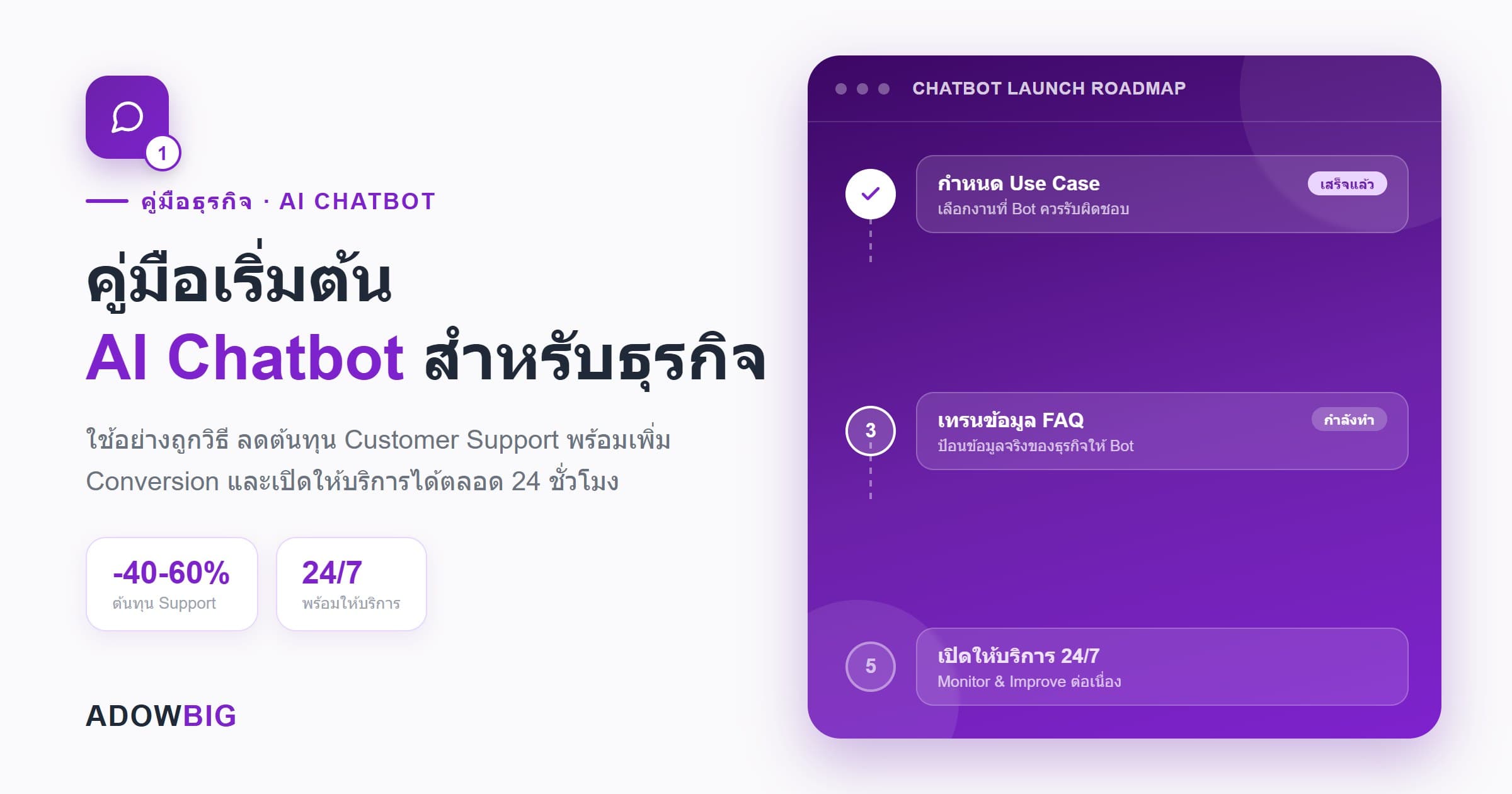
1. Customer Service Chatbot That Actually Works
The old problem: CS teams answer the same questions hundreds of times daily — "What provinces do you ship to?" or "How do I cancel an order?"
LLM solution: A chatbot trained on company knowledge (FAQ, policies, product catalog) that answers questions without scripting every possible scenario.
ROI: CS team workload reduced 40–60%, freeing them for complex issues AI can't handle.
2. Document Summarization
The old problem: Reading long contracts, reports, and emails every day.
LLM solution: Upload a document → LLM summarizes to bullet points in 10 seconds, and can answer questions about the content.
Where it applies: Law firms, financial services, mid-sized companies with heavy documentation.
3. Content Generation
The old problem: Writing product descriptions, blog posts, and social media takes significant time.
LLM solution: Rapidly generate drafts that the marketing team edits — instead of writing from scratch.
ROI: Content production time reduced 50–70% while maintaining quality flexibility.
4. Internal Knowledge Base (RAG System)
The old problem: New employees don't know where to find policies, processes, and SOPs — they have to ask senior colleagues constantly.
LLM solution: A Retrieval-Augmented Generation (RAG) system — LLM + company documents — where employees ask in natural language and get answers drawn from actual company documents.
ROI: Onboarding 50% faster; senior staff freed from repetitive questions.
5. Code Assistant for Internal Dev Teams
The old problem: Developers spend significant time writing boilerplate code, complex queries, or tests.
LLM solution: GitHub Copilot or Cursor — AI suggests code, explains existing code, and finds bugs.
ROI: Developer productivity increases 30–40%, according to GitHub research.
Use Cases Where LLMs "Don't Fit Well"
LLMs are not a silver bullet. Avoid using them when:
- Real-time accuracy is critical — such as stock prices or current weather (LLMs aren't updated in real-time without connected tools)
- 100% accuracy is mandatory — LLMs can "hallucinate" (generate plausible-sounding but incorrect information)
- Confidential data without secure infrastructure — a data privacy plan must come first
A Framework for Evaluating AI Use Cases
Before investing in AI, evaluate with four questions:
- Do we have data? — AI needs context; without data, it can't help much
- Is this a high-volume or repetitive task? — AI ROI is highest at scale
- Is error acceptable? — if mistakes cause serious damage, human review is required
- Build vs. buy? — is there a SaaS tool that already does this well enough? If yes, don't build custom
How Thai SMEs Can Get Started
A 4–6 week pilot project:
- Choose 1 use case with the clearest impact
- Define success metrics upfront (e.g., reduce CS tickets by 30%)
- Build a prototype using the API before a production rollout
- Test with 20–50 internal users first
- Measure → iterate → scale
Summary
LLMs and generative AI aren't the future — they're the present, and businesses that adopt early build compounding advantages.
But the most important thing is starting from a real problem, not technology for technology's sake.
Want to build an AI chatbot or AI-powered features for your business? Contact the Adowbig AI team.