"Is ERP good?" is the wrong question. The right question is: "Is ERP right for our business right now, and does it deliver worthwhile returns?"
This article walks you through a serious ERP ROI analysis before committing your budget.
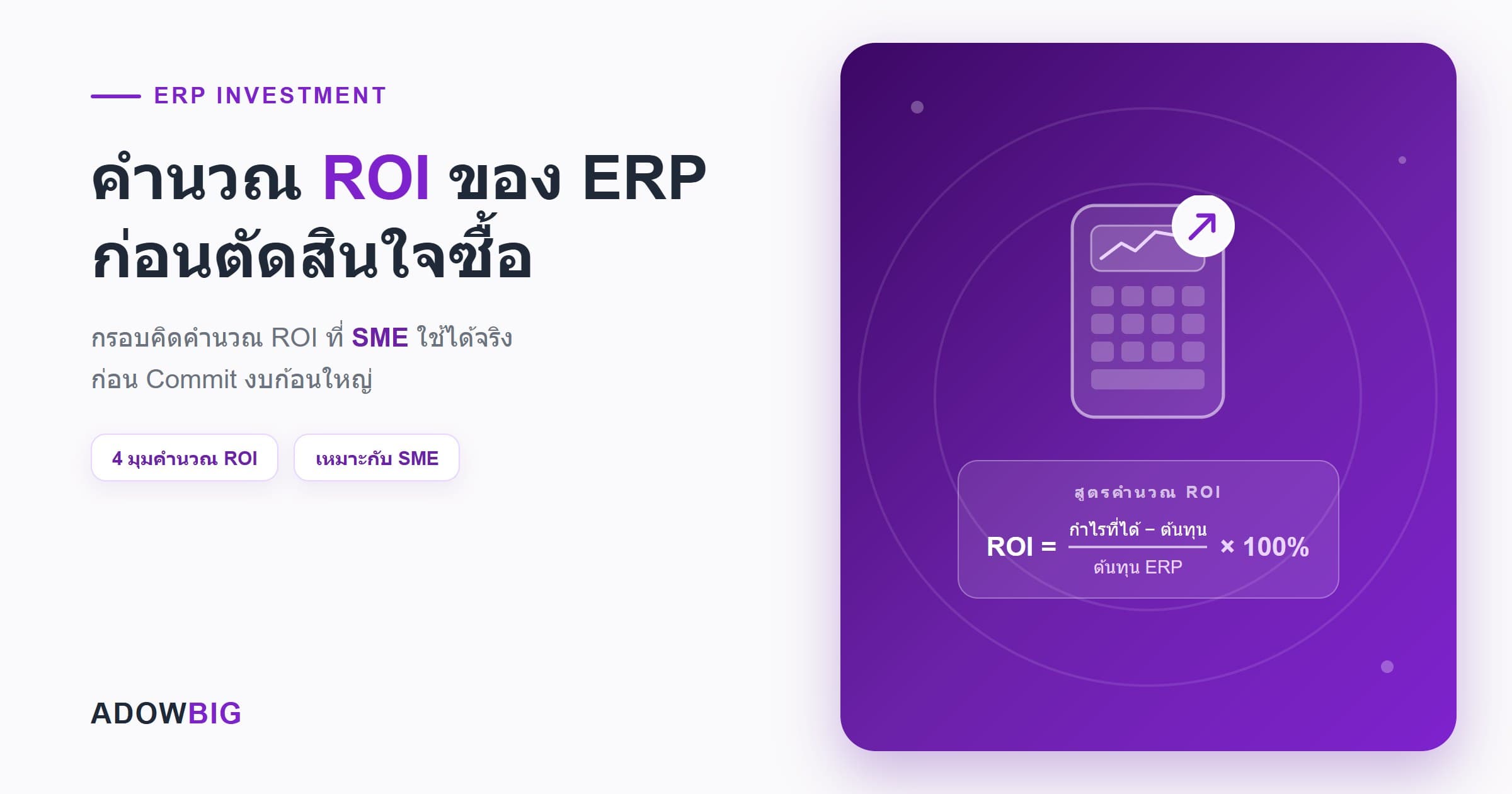
What Is ROI in the ERP Context?
Return on Investment (ROI) = (Benefit - Cost) / Cost × 100%
For ERP:
- Cost = license fees + implementation + training + maintenance + hidden costs
- Benefit = efficiency savings + revenue increases + reduced risk
Step 1: Calculate Total Cost of ERP
1.1 Software License Cost
| ERP Type | Cost |
|---|---|
| Open source (Odoo Community) | Free (but requires paid implementation) |
| Cloud/SaaS (Odoo Enterprise, NetSuite) | 15,000–200,000 THB/month by user count |
| On-premise (SAP, Oracle) | Millions for initial licensing |
| Custom ERP | 800,000–5,000,000+ THB development cost |
1.2 Implementation Cost
Typically 1–3x the annual license cost. For custom ERP, it equals the total development cost.
1.3 Training Cost
- End-user training: 5,000–20,000 THB per person per module
- Admin training: 15,000–50,000 THB
- Internal documentation creation: significant staff hours
1.4 Hidden Costs People Forget
- Productivity dip — staff need 2–6 months to learn the new system; expect 20–30% efficiency drop during this period
- Data migration — cleaning, transforming, and loading legacy data
- Process re-engineering — some workflows must change for ERP to work
- Change management — consultants, communication, incentives
Step 2: Calculate Expected Benefits
2.1 Labor Efficiency Savings
Method:
- List tasks ERP will automate or accelerate
- Time saved per task × monthly frequency
- Convert to FTE (Full-Time Equivalent) savings
Example:
| Process | Before ERP | After ERP | Monthly Savings |
|---|---|---|---|
| Create PO | 30 min × 100/month | 5 min | 41.7 hrs ≈ 25,000 THB |
| Reconcile accounts | 2 days/month | 0.5 days | 1.5 days ≈ 12,000 THB |
| Management reporting | 3 days/month | Real-time | 3 days ≈ 24,000 THB |
Total savings/month ≈ 61,000 THB = 732,000 THB/year
2.2 Error Reduction Savings
Calculate the cost of pre-ERP errors:
- Inventory discrepancy costs (lost stock, over-ordering)
- Billing error costs (credit notes, disputes)
- Compliance penalty costs
2.3 Revenue Enhancement
Some ERP modules can directly increase revenue:
- CRM module → better lead conversion
- Demand forecasting → fewer stock-outs → capture more potential sales
- Better pricing intelligence → improved margins
2.4 Risk Reduction
Quantify the risks ERP reduces:
- PDPA compliance risk (penalties for data breaches)
- Audit risk (insufficient documentation)
- Key-person dependency risk (when one person holds all the knowledge and leaves)
Step 3: Calculate ROI and Payback Period
Formulas
ROI (%) = (Total Benefit - Total Cost) / Total Cost × 100
Payback Period = Total Cost / Annual Benefit (years)
NPV = Σ (Year n Benefit / (1+r)^n) - Total Cost
(r = discount rate / company cost of capital)
Real SME Example
| Item | Amount |
|---|---|
| Implementation cost | 1,200,000 THB |
| Annual maintenance | 180,000 THB |
| Annual benefit | 900,000 THB |
| Net benefit Year 1 | -480,000 THB |
| Net benefit Year 2 | +720,000 THB |
| Payback period | ~2 years |
| 5-year ROI | 187% |
Red Flags in ERP Proposals
Watch for these when reviewing vendor proposals:
- No current process assessment — proposing without understanding fit
- Unrealistically high ROI promises — "50% cost reduction in 6 months" rarely happens
- Hidden costs not mentioned — no discussion of training, data migration, productivity dip
- Extreme vendor lock-in — over-customized to the point where upgrades become impossible
Summary
Good ERP decisions require serious ROI analysis — not gut decisions or "because our competitor does it."
Simple framework:
- Calculate Total Cost of Ownership including all hidden costs
- Quantify measurable benefits — not just assumptions
- Calculate payback period and 3–5 year ROI
- Assess implementation risk
If the payback period exceeds 4–5 years or ROI is unclear, evaluate alternatives first.
Need an ERP feasibility assessment for your business? Talk to the Adowbig team before committing.