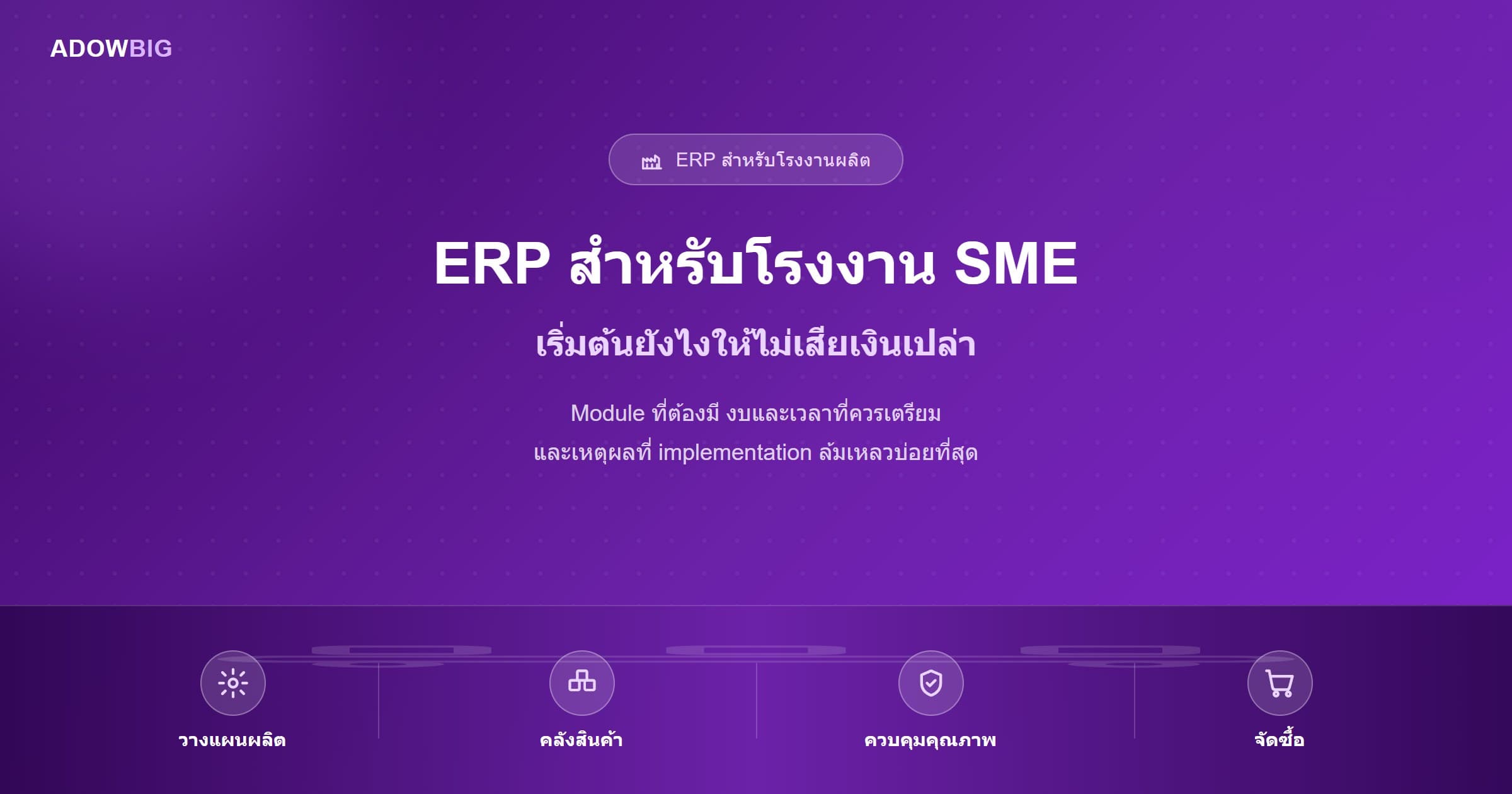
Most small-to-medium Thai factories still manage production with Excel, WhatsApp, and paper. This works fine early on, but when orders increase, teams grow, or customers demand traceability — the old system starts breaking down.
ERP (Enterprise Resource Planning) is the answer. But many factories buy an ERP only to implement it poorly, or end up using just 20–30% of what they paid for. This article helps you start correctly.
Why Do So Many SMEs Fail at ERP Implementation?
From Adowbig's experience, the top 5 root causes are:
- Scope too large from the start — implementing all modules simultaneously overwhelms the team
- Dirty data going in — starting implementation before master data is cleaned up
- Insufficient team training — buying the system without teaching anyone to use it
- Lack of management buy-in — teams revert to Excel because no one enforces the change
- Vendor unfamiliar with manufacturing — getting a generic system that doesn't fit factory operations
ERP Modules Manufacturing SMEs Actually Need
Phase 1 — Foundation (Start Here)
Inventory Management
- Track all raw materials and finished goods stock
- Multi-location (multiple warehouses)
- Lot tracking and serial numbers for traceability
- Reorder point alerts when stock runs low
Purchase Management
- Auto-generate POs when stock falls below reorder point
- Goods receipt and invoice matching
- Vendor management
Sales Order Management
- Accept orders, create quotations, issue delivery orders
- Check stock availability before confirming
Phase 2 — Production
Manufacturing / MRP
- Bill of Materials (BOM) — production formulas
- Work order management
- Material Requirements Planning — calculate material needs in advance
- Production tracking and yield management
Quality Control
- Incoming material inspection
- In-process quality checks
- Finished goods inspection
Phase 3 — Finance & Analytics
Accounting
- Automated COGS calculation
- Landed cost tracking
- Financial reporting
Business Intelligence
- Production performance dashboard
- OEE (Overall Equipment Effectiveness)
- Per-product cost analysis
Realistic Timeline and Budget
Small Factory (< 30 employees)
- Timeline: 3–4 months (Phase 1 only)
- Budget: THB 300,000–500,000 (Odoo/ERPNext)
- Modules: Inventory + Purchase + Sales
Mid-Size Factory (30–100 employees)
- Timeline: 6–9 months (Phase 1 + 2)
- Budget: THB 600,000–1,200,000
- Modules: Full Phase 1 + Manufacturing + QC
Large Factory (100+ employees)
- Timeline: 9–18 months
- Budget: From THB 1,500,000
- Consider SAP B1 or Oracle NetSuite
7 Steps for a Successful Implementation
- As-Is Process Mapping — document all current workflows before starting
- Data Cleaning — clean master data: products, item codes, vendors, BOMs
- Phase Planning — break implementation into realistic smaller phases
- Champion Training — train "super users" in each department before the full rollout
- Parallel Run — run ERP alongside the old system for 2–4 weeks
- Go-Live Cutover — a clearly defined date when the old system stops
- Hypercare Period — intensive support for 4–8 weeks after go-live
Conclusion
ERP for manufacturing SMEs isn't impossibly complex — it requires solid planning and management commitment. Start small with quick wins, then expand, rather than trying to implement everything at once and failing halfway through.
Adowbig specializes in ERP implementation for manufacturing SMEs, with a focus on Odoo and ERPNext. Contact us for a free assessment and a roadmap tailored to your factory.