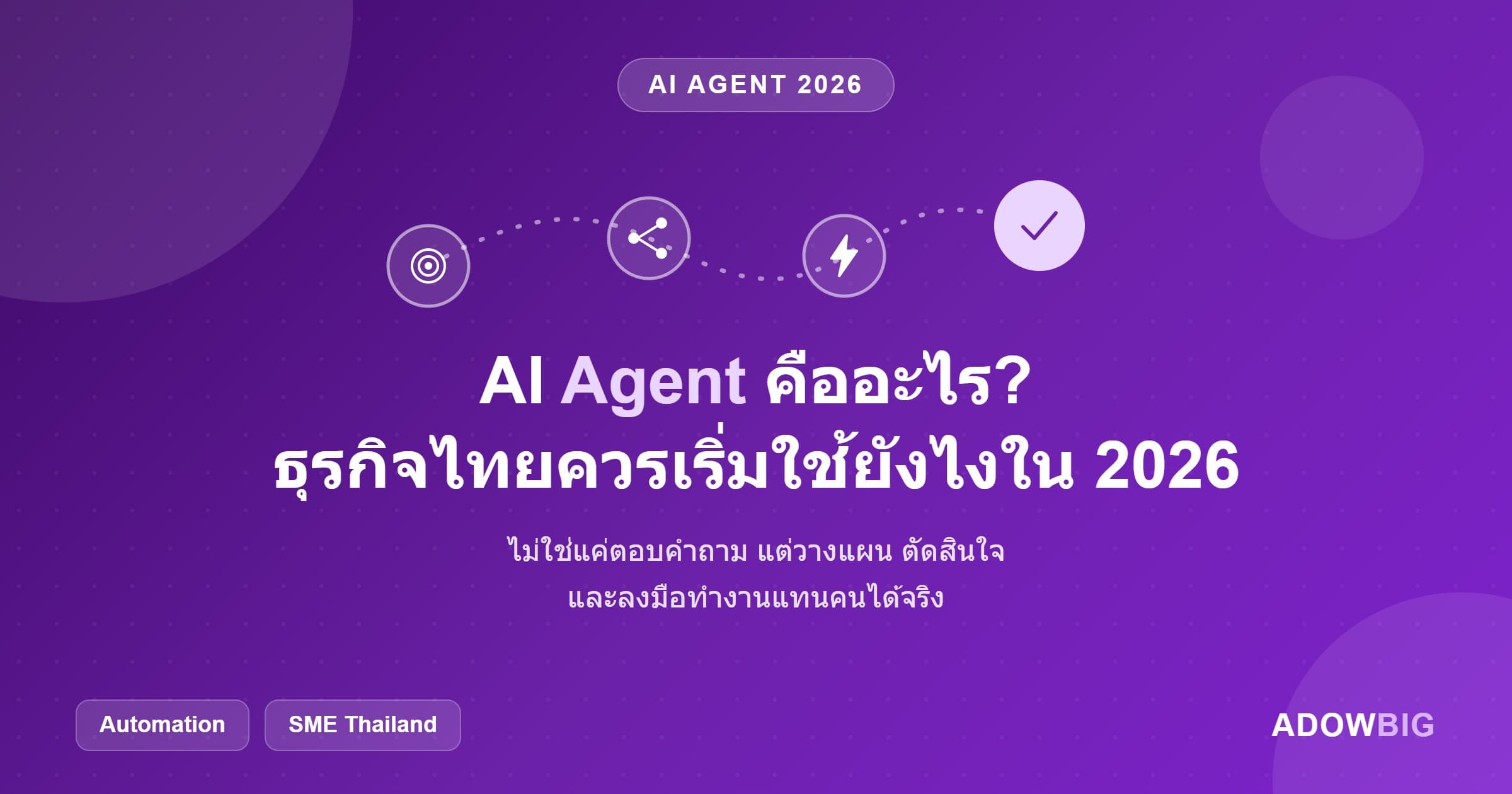
If 2023 was the year people discovered ChatGPT, and 2024–2025 saw AI chatbots go mainstream, then 2026 is the year of the AI Agent.
But one question still confuses most people: what's the difference between an AI agent and an AI chatbot? And should Thai SMEs care right now?
What Is an AI Agent?
An AI agent is an AI system that can:
- Receive a goal (not just a question)
- Plan a sequence of steps to achieve that goal
- Use tools like APIs, search engines, and code execution
- Execute each step automatically
- Check results and adjust the plan when needed
The simple comparison:
- Chatbot = a receptionist who answers questions on the phone
- AI Agent = an assistant who takes a brief, goes away, completes the work, and reports back
Real AI Agent Examples in Business
1. Report Generation Agent
Goal: "Generate this week's sales report"
- Pulls data from the ERP
- Compares against the previous week
- Creates charts and a PDF summary
- Emails it to executives every Friday evening
Result: Saves analysts 3–5 hours per week
2. Lead Research Agent
Goal: "Research Company ABC before tomorrow's meeting"
- Searches for latest company news
- Pulls data from LinkedIn
- Reviews their website and job postings
- Sends a context summary to the sales team
Result: Saves 1–2 hours of pre-sales research per meeting
3. Customer Support Escalation Agent
Goal: Receive complaints and route based on severity
- Reads and analyzes incoming complaints
- Routine issues: responds automatically with resolution steps
- Urgent issues: creates a ticket and assigns to the right team immediately
- Sends status updates to the customer throughout
Result: Response time drops from 4 hours to < 30 minutes
How AI Agents Work
[Goal Input]
     ↓
[Planning Module] — breaks goal into sub-tasks
     ↓
[Tool Selection] — picks the right tools
     ↓
[Execution] — runs tools sequentially (API, Search, Code)
     ↓
[Observation] — reviews tool output
     ↓
[Reasoning] — decides next step or finalizes
     ↓
[Output]
Popular AI Agent Frameworks in 2026
| Framework | Level | Best for |
|---|---|---|
| n8n | Low-code | SME automation workflows |
| Make.com | Low-code | Non-dev teams |
| LangChain | Code-first | Developers needing full control |
| AutoGen | Advanced | Multi-agent coordination |
| CrewAI | Advanced | Teams of specialized agents |
3 Use Cases Thai SMEs Should Start With
Use Case 1: Email Triage Agent
Monitors your inbox, categorizes emails, and drafts initial replies for common inquiries — immediate workload reduction for your team.
Use Case 2: Document Summarization Agent
Send contracts, reports, or meeting notes to the agent; receive bullet-point summaries with highlighted key points — saves 60–80% reading time.
Use Case 3: Inventory Monitoring Agent
Checks stock levels daily. When items run low → sends an alert → creates a draft purchase order → waits for manager approval.
How to Start with Low Risk
- Choose the smallest possible use case — repetitive, time-consuming, low-impact if something goes wrong
- Start human-in-the-loop — have the agent complete work, then require human approval for every action
- Measure for 4–8 weeks — track time saved and output quality
- Gradually increase autonomy — reduce human review as confidence grows
- Expand to more use cases — one at a time
Conclusion
AI agents are no longer a future concept — they're deployable today for businesses of every size. The key for Thai SMEs is to start small, see fast results, and scale with confidence.
Adowbig designs, develops, and integrates AI agents with your existing systems — whether that's your ERP, CRM, or custom software. Contact us for a free consultation to model the ROI for your specific workflows.