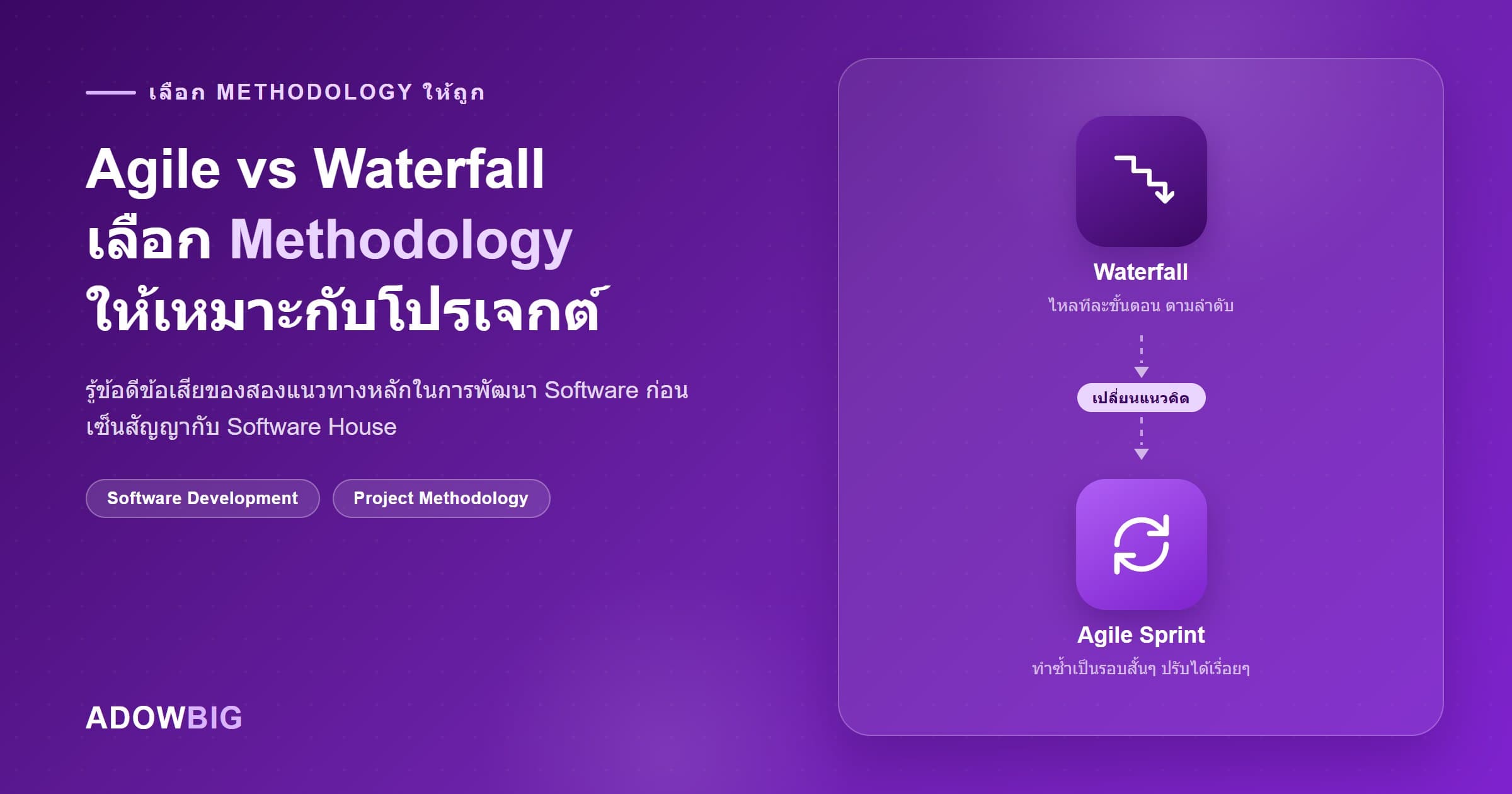
When meeting with a software house, you'll often hear "Agile" or "Waterfall." But many business owners aren't sure what these terms mean or how they affect their project.
Understanding both methodologies helps you set the right expectations and choose a software house you can work with effectively.
What Is Waterfall?
Waterfall is the traditional methodology that divides a project into fixed, sequential phases — like water flowing in one direction.
Waterfall phases:
- Requirements — gather all requirements first
- Design — design the entire system
- Development — code all features
- Testing — test once after development is complete
- Deployment — deploy when QA is passed
- Maintenance — post-launch support
Key characteristics:
- All requirements must be known from the start
- Changes mid-project are difficult and costly
- Clients see the product for the first time at go-live
What Is Agile?
Agile is a philosophy of software development that emphasizes flexibility, collaboration, and delivering value in short iterative cycles.
Core Agile principles (from the 2001 Agile Manifesto):
- Individuals and interactions over processes and tools
- Working software over comprehensive documentation
- Customer collaboration over contract negotiation
- Responding to change over following a plan
How Agile works in practice (using Scrum):
- Development is divided into Sprints (2-week cycles)
- Each sprint delivers genuinely testable features
- Clients review and provide feedback after every sprint
- Priorities can be adjusted throughout the project
Direct Comparison
| Factor | Waterfall | Agile |
|---|---|---|
| Flexibility | Low | High |
| When you first see the product | End of project | Every 2 weeks |
| Can requirements change? | Difficult | Easy |
| Client involvement | Start + end only | Throughout project |
| Risk management | High if requirements are wrong | Risk spread across sprints |
| Budget predictability | More certain | Variable |
| Documentation | Comprehensive | Minimal but sufficient |
| Best for | Clear, fixed scope | Changeable requirements, MVP |
When to Use Waterfall
Waterfall still works well in specific situations:
✅ Clear, stable requirements — e.g., a data migration project ✅ Regulatory compliance — projects requiring documented proof at every stage ✅ Fixed budget and fixed scope — when everything is agreed upfront ✅ Fully separated vendor relationship — large government or enterprise outsourcing
When to Use Agile
Agile fits the majority of modern software development:
✅ Requirements that will change — which happens in nearly every real project ✅ Startups / MVPs — need real user feedback as fast as possible ✅ Clients who can stay involved — have time to review every sprint ✅ Need to launch some features before others — don't want to wait for everything ✅ Fast-changing markets — e-commerce, mobile apps, SaaS
Hybrid Approach — What Real Software Houses Actually Do
In practice, most professional software houses use a Hybrid Approach:
- Discovery Phase — Waterfall-style (define scope, wireframes, tech stack first)
- Development — Agile sprints
- Go-Live — Waterfall-style UAT
- Post-Launch — Agile backlog for new features
This provides scope (and pricing) clarity upfront while preserving flexibility during development.
Questions to Ask Your Software House
When evaluating software houses, ask:
- "What methodology do you use? Walk me through your process."
- "How often does the client review the work?"
- "If requirements change, what's your change request process?"
- "Is there a prototype or demo before full development begins?"
Vague answers or no clear process are red flags.
Summary
| Your Situation | Choose |
|---|---|
| Clear requirements, fixed price | Waterfall |
| Changing requirements, MVP | Agile |
| Balance of both | Hybrid |
For most Thai SMEs, Agile or Hybrid delivers better outcomes — because in the real world, business requirements change constantly.
The Adowbig team uses an Agile-based process with Sprint Reviews every 2 weeks, keeping you engaged throughout the project. Contact us to learn more